
Science
Premium water is a growing category in India — and the labels on bottles are increasingly sophisticated. “Himalayan,” “natural mineral,” “mineral-enriched,” “natural spring” — the language implies quality but obscures real differences that matter to health-conscious consumers.
Let’s break down the key distinctions clearly.
What is Himalayan natural water?
Himalayan natural water is water collected from specific spring sources within the Himalayan mountain range. The defining characteristic is that it is bottled at source — meaning it is collected and sealed without significant processing or mineral alteration.
As water percolates through Himalayan geology over many years, it naturally absorbs minerals from the rock — calcium, magnesium, bicarbonates, and trace elements — in concentrations shaped by the specific geological composition of each catchment. This gives genuine Himalayan water a distinct mineral profile and a crisp, clean taste that reflects its source.
Key characteristics:
- Sourced from a specific, identified spring catchment
- Mineral content is naturally occurring — not added
- Cannot be demineralised and re-mineralised and still carry this designation
- Taste reflects source geology — typically clean, light, and slightly alkaline
What is mineral-enriched drinking water?
Mineral-enriched water starts as purified water — typically filtered through reverse osmosis or similar processes that remove both contaminants and naturally occurring minerals. Minerals are then re-added in controlled concentrations.
This is not inferior to natural mineral water — in fact, it has a significant advantage: precision. The mineral concentrations can be scientifically calibrated to optimal levels for human health, rather than being dictated by the specific geology of a source. A well-formulated mineral-enriched water can deliver optimal calcium-to-magnesium ratios that natural sources may not naturally provide.
The key differences
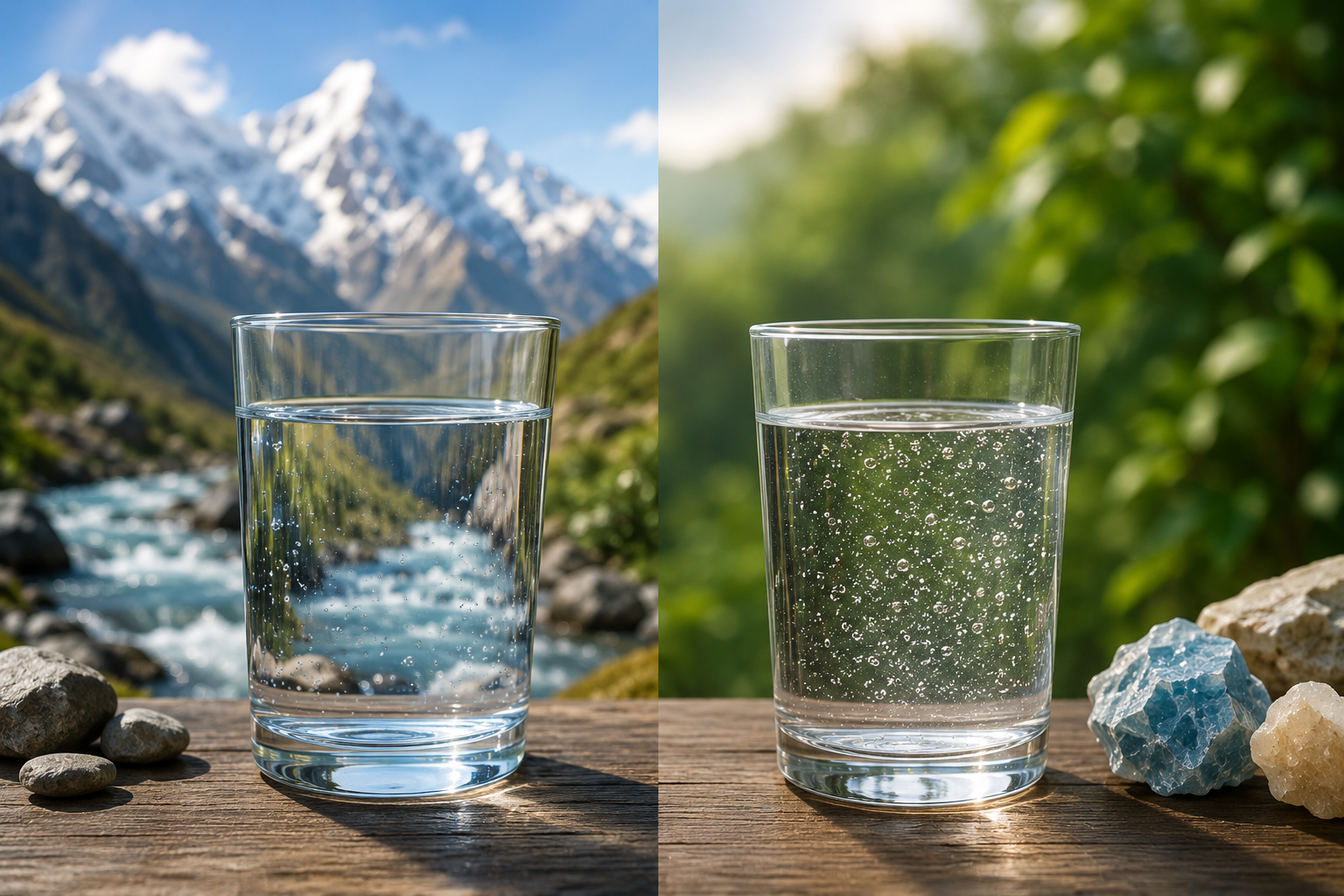
At their core, the two product types reflect different philosophies. Natural Himalayan water celebrates the authenticity and heritage of a specific source — you are drinking the product of ancient geology and pristine environment. Mineral-enriched water represents a science-forward approach — delivering precisely what the body needs in exactly the right concentrations.
Neither is categorically better. They serve different consumer values:
- If you want provenance, taste authenticity, and the experience of natural purity — Himalayan natural water is the choice
- If you want optimised daily mineral intake with guaranteed concentrations — mineral-enriched water delivers more consistency
- If you want functional wellness benefits beyond standard minerals — copper + zinc fortified water is a third category entirely
What about “packaged drinking water”?
Most mass-market bottled water sold in India is classified as packaged drinking water — purified through RO, UV, or ozonation, with no significant mineral content added back. Brands like Bisleri (standard), Aquafina, and Kinley fall in this category. These are safe and hygienic, but provide no meaningful mineral contribution.
How to read a water label
When choosing premium water, check the label for:
- TDS (Total Dissolved Solids) — this indicates mineral content; natural Himalayan water typically reads 150–300 mg/L; good mineral-enriched water similar; packaged drinking water usually under 50 mg/L after RO
- Source declaration — a premium product should tell you exactly where the water comes from
- Calcium and magnesium content — the two minerals most important for daily hydration
- pH level — slightly alkaline (7.5–8.2) is considered optimal for regular consumption
Austiva’s three ranges are designed to serve every point on this spectrum — giving you the option to choose based on your wellness priorities, without compromising on quality at any level.